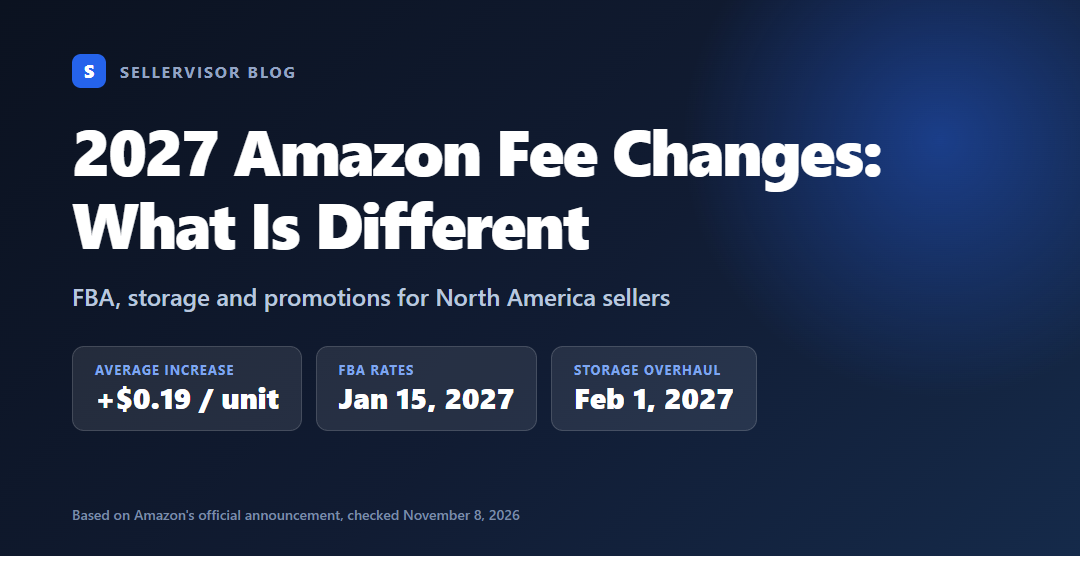
Amazon announced changes to US selling fees and FBA rates for 2027 on November 5, 2026. To summarize in one sentence: From January 15, 2027, FBA shipping fees and size tiers will change, and from February 1, storage fees and low-inventory fee structures will be reorganized. The average increase is approximately $0.19 per item, but this number is not the answer for your product. In the same announcement, some products will increase by $0.06 and some by $0.44.
This article organizes, in order, only the points that North American Amazon sellers need to actually check in 2027, based on Amazon's official announcement and actual rate lookup screens. All amounts are based on verification as of November 8, 2026, and the final billed amount must be re-verified with your product's rates in Seller Central.
1. 2027 Amazon Fee Changes, 3-Sentence Summary
First, from January 15, 2027, most FBA shipping rates and size tiers will change. Small standard-size products will increase by $0.20 to $0.70 per item depending on the selling price range, and large standard-size products will increase by $0.12 to $0.47.
Second, from February 1, 2027, the storage fee structure will be unified. Instead of the storage utilization surcharge, which was previously imposed in addition to the basic storage fee, the unified storage fee for inventory aged over 181 days will increase. The method for determining low-inventory fees will also change.
Third, starting February 2027, promotion costs will be billed monthly, and a fee (fixed $5 + variable 2%) will be newly introduced for Buy X Get Y. AWD, MCF, and MCD rates will also be adjusted at the same time.
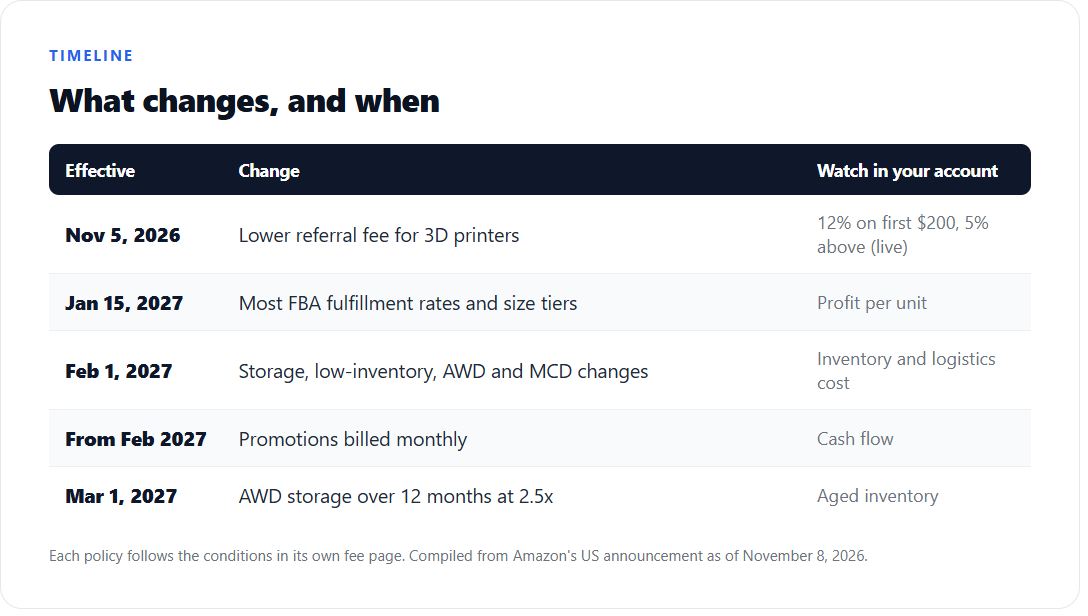
The key to the schedule is that January 15 and February 1 must be viewed separately. January 15 is a matter of per-item profit, and February 1 is a matter of inventory and logistics costs. If you calculate both dates as one lump sum, you won't know which one is cutting into your profits.
2. FBA Shipping Fees: How Much Will Standard-Size Products Increase?
This is the table you should look at first. The increase varies completely depending on the selling price and size tier.
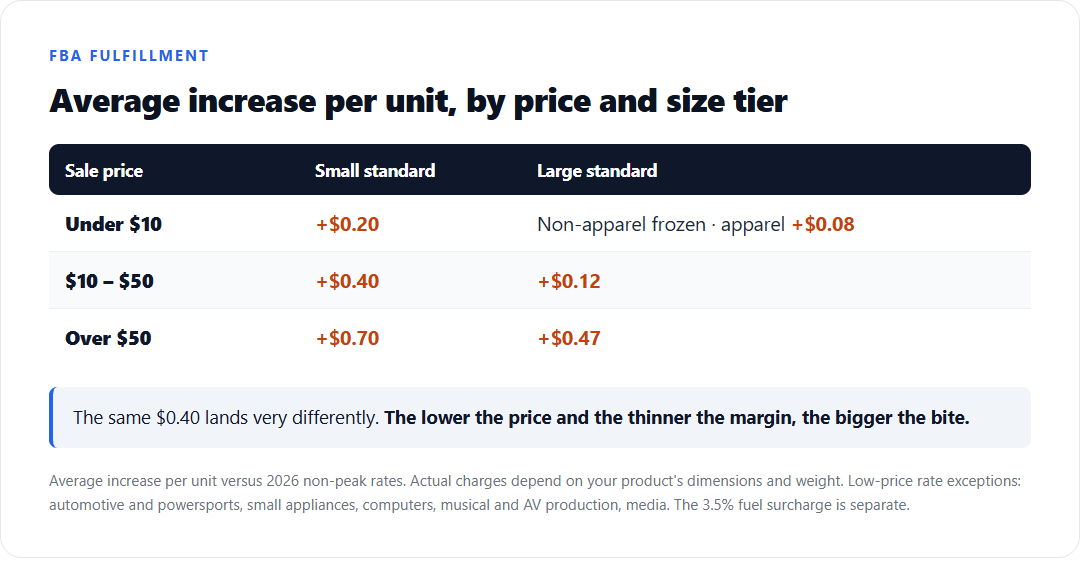
What stands out is that small standard-size products in the $10 to $50 range will cost $0.40 per item. This is the price range most frequently sold by Korean sellers, and simultaneously the range with the thinnest per-item profit. In contrast, large standard-size products at the same selling price are a moderate $0.12.
There are also exceptions to note. Low-price rates do not apply to the Automotive & Powersports, Small Appliances, Computers, Musical Instruments & AV Production, and Media categories. All the amounts above are basic rates, and a 3.5% fuel surcharge is added separately. The actual billed amount will be recalculated based on the product's specifications and weight.
3. How Much is $0.40 in My Profit?
Fee increases should be viewed not by absolute amount but by their proportion of profit. Assuming a previous net profit margin of 10% and 1,000 units sold per month, it breaks down like this:
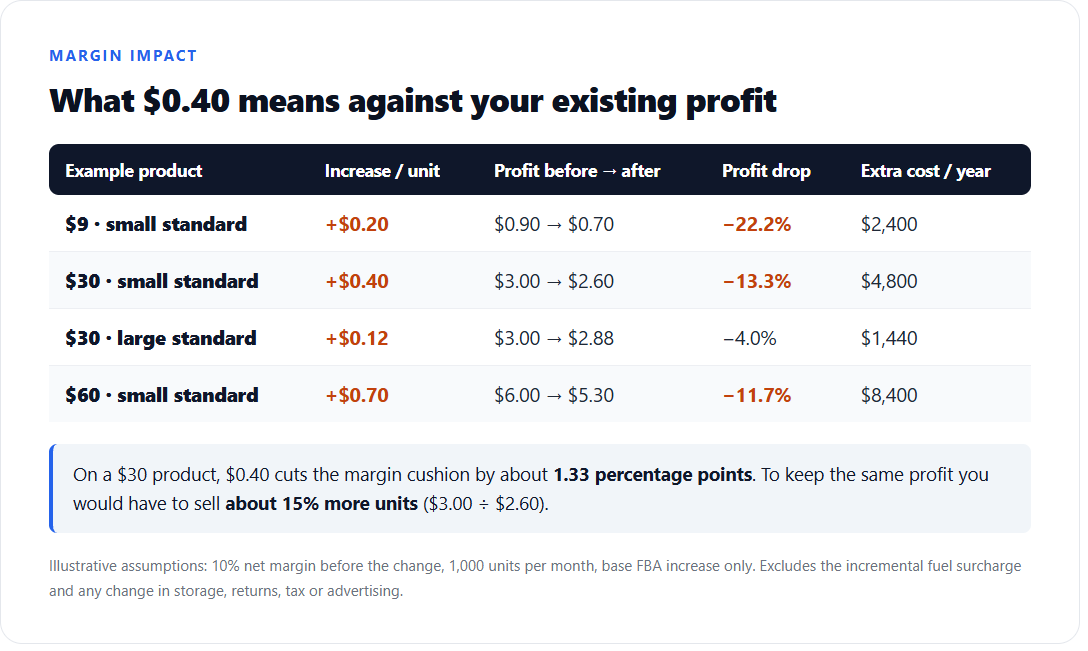
Even if a $9 product increases by just $0.20 per item, profit decreases by 22.2%. For a $30 product, $0.40 cuts profit by 13.3%, and for a $60 product, $0.70 takes away 11.7%. Low-priced, high-turnover products will feel the same announcement much more heavily.
For a $30 product, $0.40 reduces the profit margin relative to sales by approximately 1.33 percentage points. To cover this loss with sales volume, you would need to sell about 15% more. Between increasing sales volume and reducing advertising costs or return rates, choosing what you can address now is more realistic.
4. The Trap of the Average +$0.19 Calculated from 5 Real Products
Comparing the off-peak FBA shipping fees for the 5 disclosed products between 2026 and 2027 is as follows. Amounts per item include a 3.5% fuel surcharge.
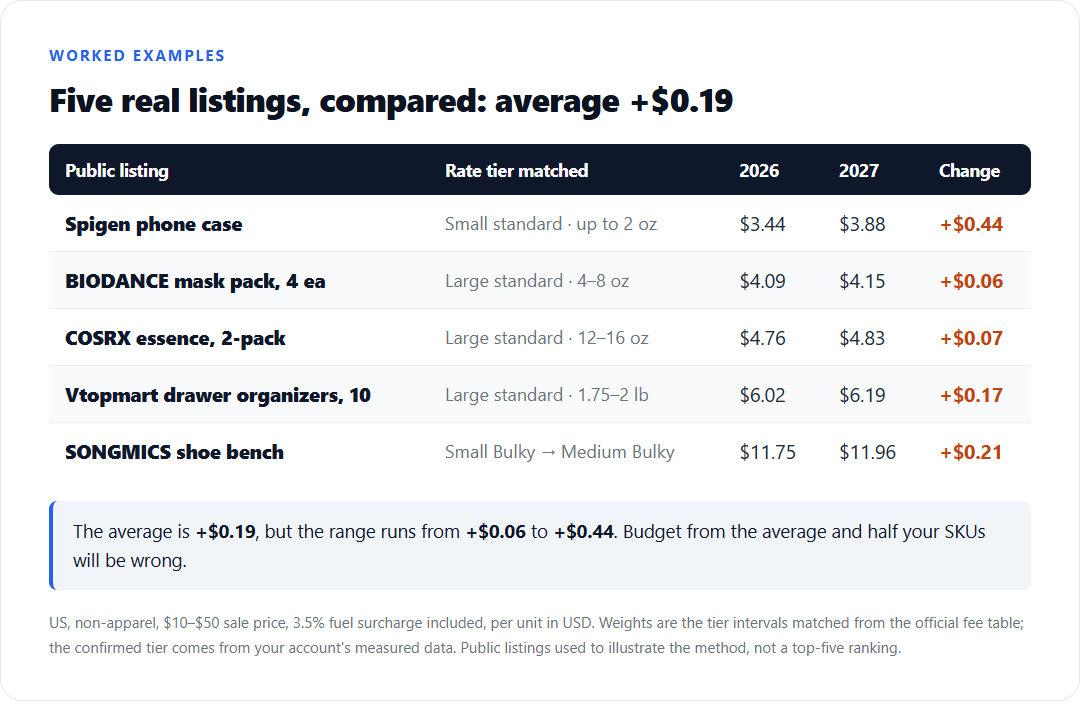
The average is +$0.19. However, the Spigen mobile case, which increased the most, is +$0.44, and the BIODANCE mask pack, which increased the least, is +$0.06. That's a seven-fold difference. If a budget is set using the average, some sellers will underestimate, and others will implement unnecessary price increases.
The second fact to read from the same table is that some products move across rate tiers. For example, the foldable shoe rack bench changes from Small Bulky to Medium Bulky. When a tier changes, you must look at a different row in the rate table, not just the increase percentage, so you need to re-cross-reference with the calculator.
5. You Must Compare Excluding Peak Season and Fuel Surcharges
If you look up FBA rates in Seller Central now, you will see the 2026 peak season rates. The application period is from October 15, 2026, to January 14, 2027. If you compare this amount directly with the 2027 rates, you will misinterpret the increase.
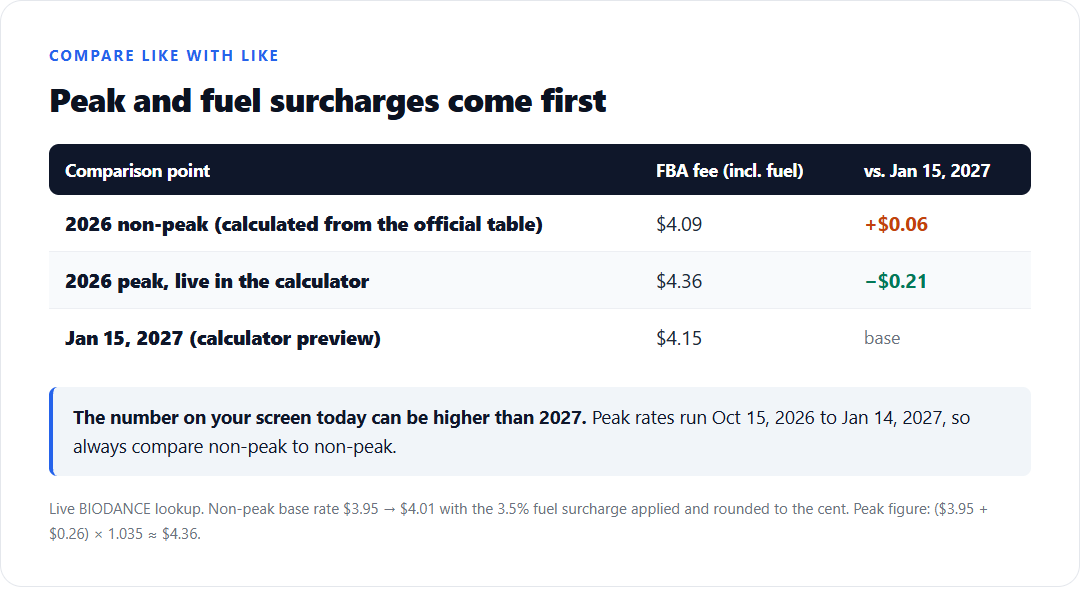
Looking at the case of the BIODANCE Mask Pack (4 sheets), the off-peak rate for 2026 was $4.09, and for 2027 it's $4.15, an increase of +$0.06. However, the peak season amount currently shown on the screen is $4.36, which is actually $0.21 higher than 2027. This is why looking only at the current screen might make it seem like fees have decreased.
Therefore, comparisons must always be made off-peak versus off-peak. The peak season surcharge is a seasonal rate, and the 2027 changes are structural. Mixing the two will prevent you from determining whether there's a price increase.
6. How to Directly Check 2027 Rates in Your Account
Other people's cases are just references. You must check the amount for your SKU directly by selecting the 2027 rate in the Amazon fee calculator. The method consists of four steps.
① Search for the ASIN in the US store. ② Expand the Fulfillment cost section. ③ Select FBA fulfillment fee rate (Jan 15, 2027) from the rate list. ④ For storage and inbound fees, select the new rate for each item. The screen below shows the actual lookup result for the BIODANCE Mask Pack ASIN. You can see the shipping fee change to $4.15 after selecting the January 15, 2027 rate.
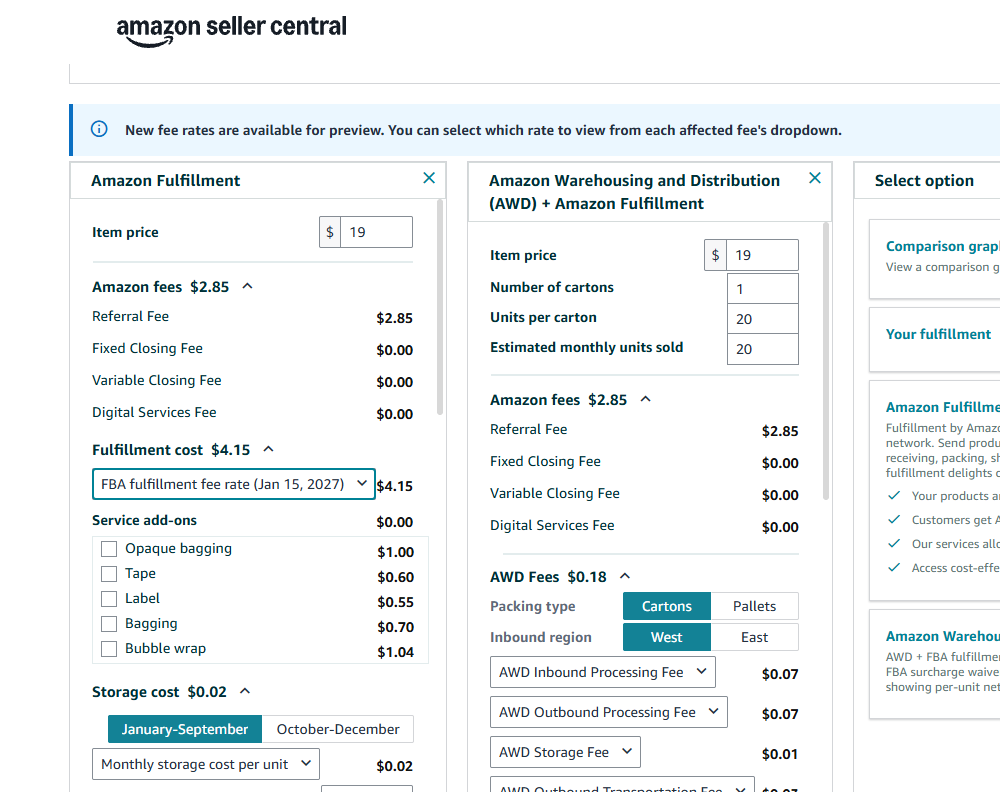
There is one thing to note on this screen. Net profit, without inputting cost of goods and advertising expenses, is not actual profit. In the calculator, only read how shipping fees and storage fees change, and it is safer to calculate final profitability separately. For products without dimension information, enter it directly in 'Define product'.
If you have many products, comparing by SKU is faster. In Seller Central's Profit Analytics Fee Change Comparison, you can see the current/new FBA rates, increase amount, and effective date for each product at a glance. On this screen, check the overall average change in 'Impact summary', then compare rates before and after by searching for ASINs in 'By product', and finally view the increase amount and effective date in the 'Fee impact' section. The reason for needing to view both the overall average and SKU-specific differences is that the average does not represent individual products, as seen in point 4.
The comparison dashboard can be opened directly to the 2027 fee comparison screen with the US store selected. Screen configuration and access permissions may vary by account.
7. February 2027 Storage Fees: Utilization Surcharge Eliminated
Until now, Amazon imposed a storage utilization surcharge, separate from basic storage fees, on sellers with large storage volume relative to their outbound shipments. The calculation is the recent 13-week average storage volume divided by the daily average outbound shipment volume, then divided by 7. If 100 ft³ is shipped out at 0.5 ft³ per day, it would be approximately 28.6 weeks.
For professional sellers whose metric exceeds 22 weeks and whose average daily storage volume per size tier is 25 ft³ or more, the fee applied to inventory exceeding 30 days will be eliminated from February 1, 2027.
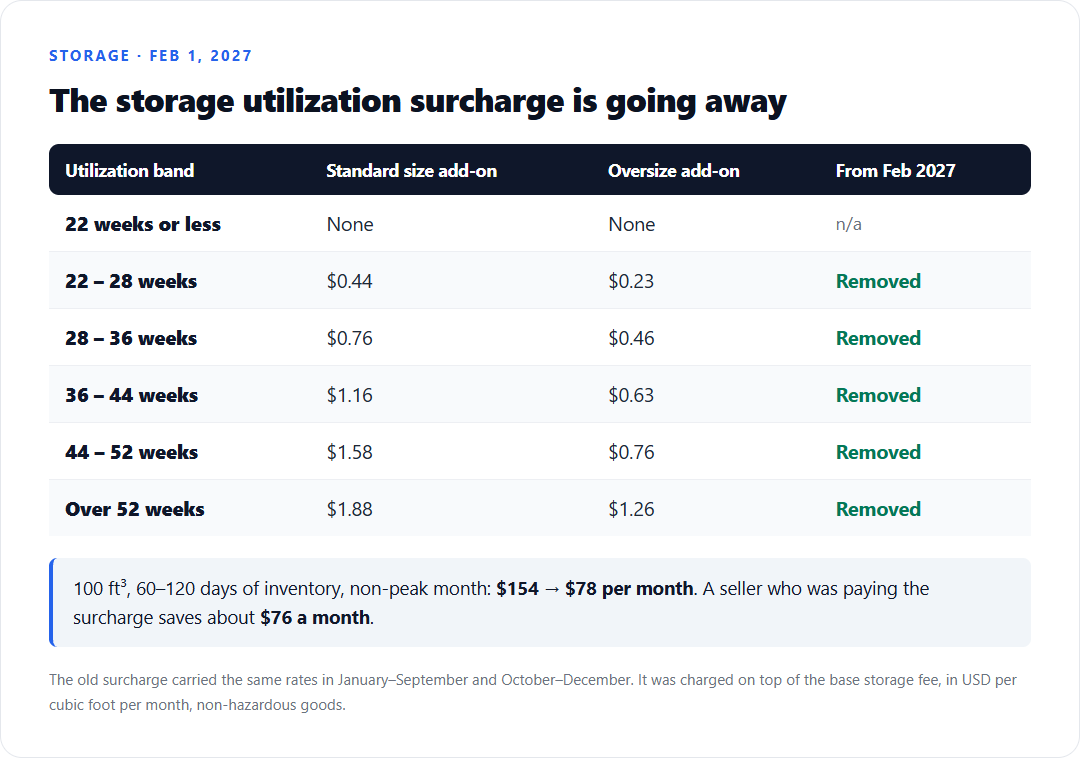
The effect is not small. Assuming a non-hazardous standard product of 100 ft³, inventory aged 60 to 120 days, and one off-peak month, it was previously $154, with a basic storage fee of $78 and a utilization surcharge of $76. After February, it will be $78. That's $76 a month, or about $912 a year.
8. Instead, Inventory Over 181 Days Will Increase
The elimination of the surcharge is not a comprehensive reduction. In the same announcement, long-term storage fees were reorganized into a unified rate based on inventory age. The 0 to 180-day segment remains unchanged, but the 181 to 330-day segment has higher new rates.
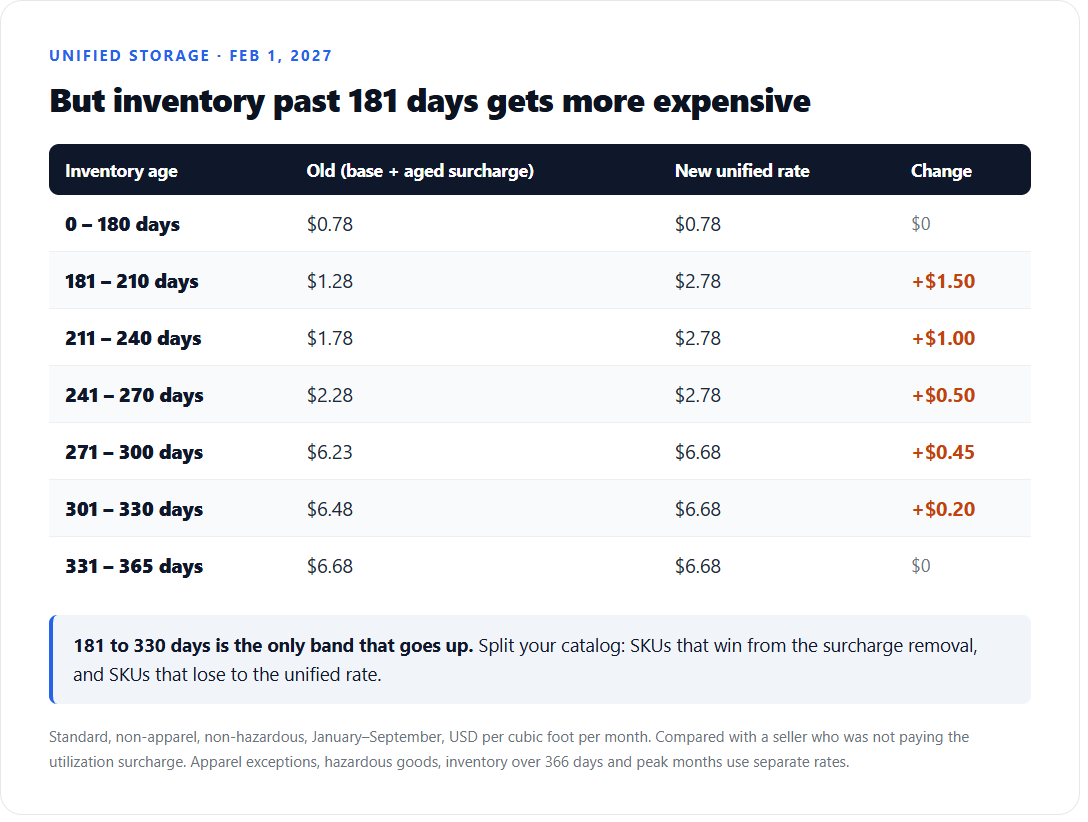
The 181 to 210-day segment more than doubles from $1.28 to $2.78. In contrast, the 331 to 365-day segment remains unchanged at $6.68. This means the increase in this revision is concentrated in the 181 to 330-day segment.
Therefore, you should divide your catalog into two categories: SKUs that benefit from the elimination of the surcharge, and SKUs that incur losses due to the unified rate. For inventory that is likely to slightly exceed 180 days, it may be more advantageous to clear it through sales or promotions before February than to hold onto it until March.
9. Low-Inventory Fee Assessment Method Changes
Low-inventory fees also change on the same day. Previously, low-inventory status was assessed based on past 30-day and 90-day sales performance. After the change, it will consider the 4 weeks prior to and 4 weeks after the current week. The core criterion remains whether the supply is less than 28 days, as before.
Amazon's stated purpose is to reduce fees unnecessarily imposed on end-of-season or discontinued products. The change aims to alleviate the problem of products with temporary demand surges being mistakenly flagged as low inventory. However, it does not guarantee automatic exemptions or cost reductions for individual SKUs, so for consistently selling SKUs, you must recheck the scope of application and replenishment timing.
10. Promotions: Buy X Get Y Monetization and Monthly Billing
The most noticeable change is in promotions. While the existing standard Buy X Get Y had no separate setup or usage fees, starting in 2027, a fixed $5 and a variable 2% (capped at $2,000) will be added. The discount amount provided to customers was always the seller's responsibility, so now you must calculate the discount and usage fee combined.
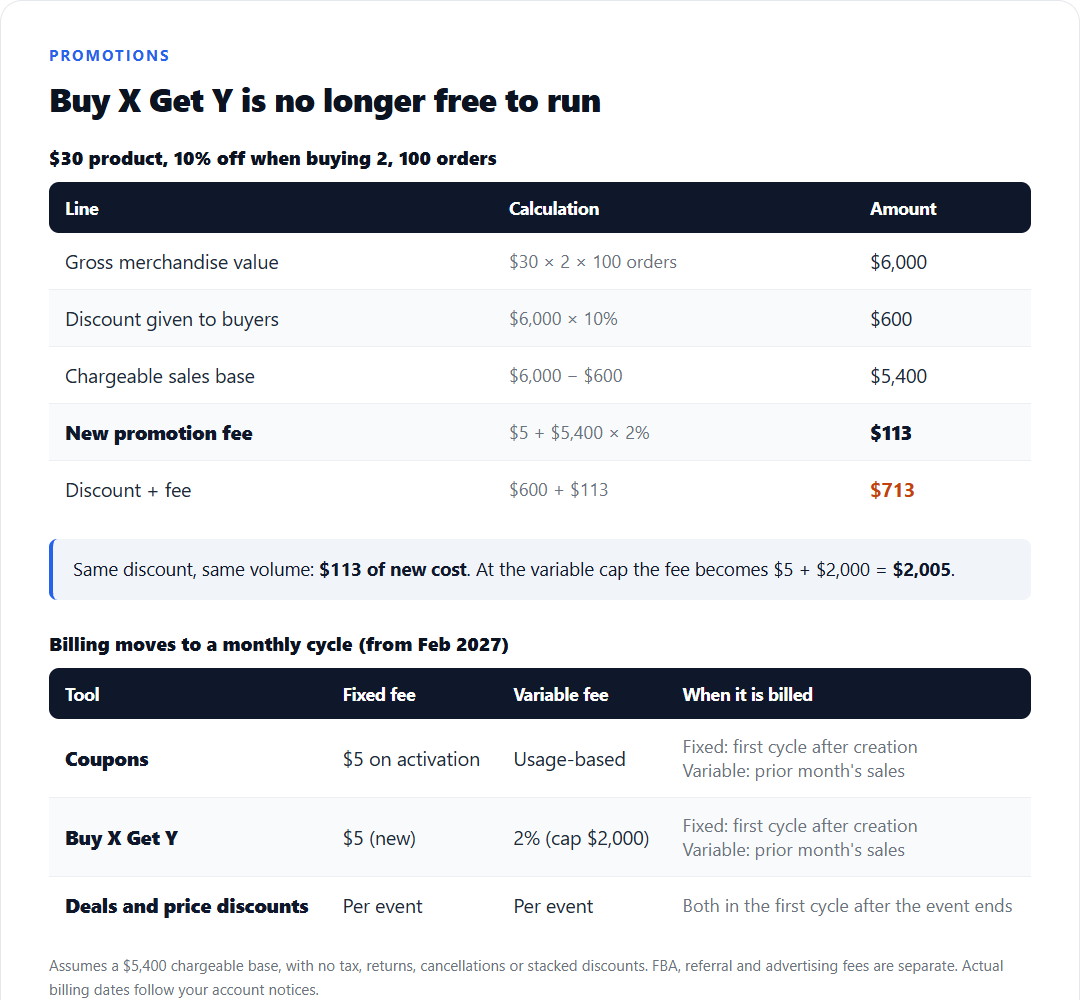
If you run a promotion offering a 10% discount on two $30 items for 100 orders, the discount amount of $600 will be加上 an additional $113 in fees. If discounts and sales performance are the same as before, $113 will be an additional cost. If the variable component hits the cap, the usage fee will increase up to $2,005.
Billing times will also change to monthly. For coupons and Buy X Get Y, fixed fees will be billed in the first monthly cycle after creation, and variable fees will be billed based on previous month's sales. For deals and price discounts, fixed and variable fees will be billed together in the first monthly cycle after the promotion ends. Since the promotion end date and the payment date will differ, it is advisable to include promotion costs separately in your monthly cash flow statement starting in February.
11. AWD, MCF, MCD: Also Consider Logistics Integration Costs
AWD is not just a storage warehouse. As of February 1, 2027, inbound and outbound processing fees are $1.55 per box each. The basic inbound and outbound processing fee for one box alone is $3.10, and a shipping fee of $1.58 per cubic foot plus a 3.5% fuel surcharge are added separately. For AWD inventory exceeding 12 months, 2.5 times the basic storage fee will apply starting March 1, 2027.
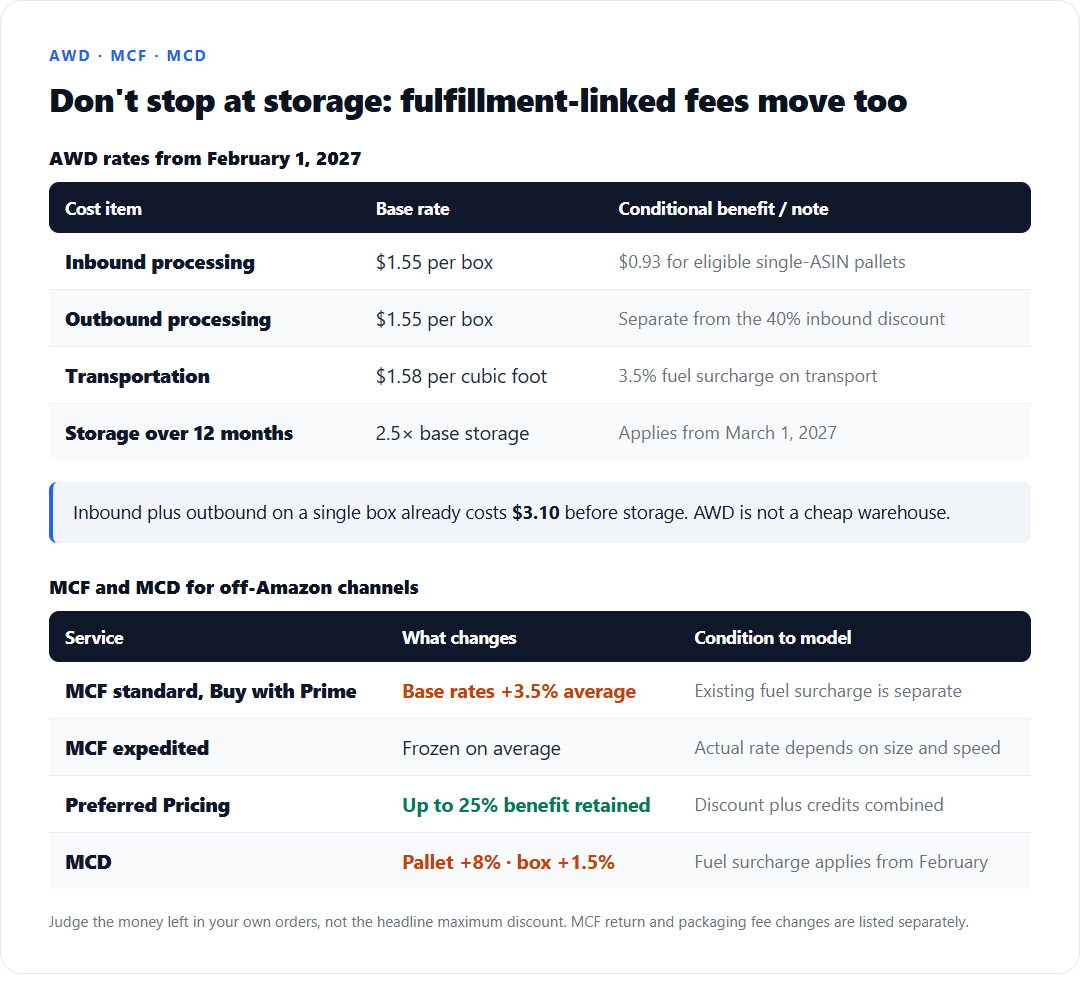
External channel shipping also changes. MCF standard shipping and Buy with Prime basic fees will increase by an average of 3.5%, while MCF expedited shipping rates will remain stable on average. Preferred Pricing benefits of up to 25% will be maintained, and MCD pallet stacking will increase by 8%, box stacking by 1.5%, with fuel surcharges also applying from February.
The criterion here is not the maximum discount displayed, but the actual amount remaining from your orders. Maximum benefits vary depending on eligibility and usage conditions, and changes to MCF return and packaging fees must be checked separately.
12. Size Tiers, Return Processing Fees, New Seller Benefits
For bulky products, both reductions and increases in the new size tiers will occur. You must compare actual weight, dimensional weight, package dimensions, and additional handling/packaging costs together.
Return processing fees are divided by target and timing. For apparel and footwear, rates reflecting the new size tiers will apply to products shipped from January 15, 2027, and for other high-return-rate categories, to products shipped from February 1, 2027. A blanket increase for all returns and all products has not been announced, so it is safer not to overinterpret. Check the amount per SKU.
There are also benefits. For 3D printers, a selling fee of 12% applies up to the first $200, and 5% for amounts exceeding that, effective from November 5, 2026. For Renewed, a 10% limited benefit for eligible categories continues until October 18, 2027. If you launch a new product, you can receive up to $600 worth of fee credits and benefits for storage, returns, liquidation, and promotions through FBA New Selection. Since there are conditions for the first 200 units, registration, and duration, it is advisable to check eligibility before launching. This is not a cash payment scheme.
13. What is Advantageous and What is Risky for Each Seller Type?
The same announcement impacts sellers in different ways. First, check which line your operating model falls under.
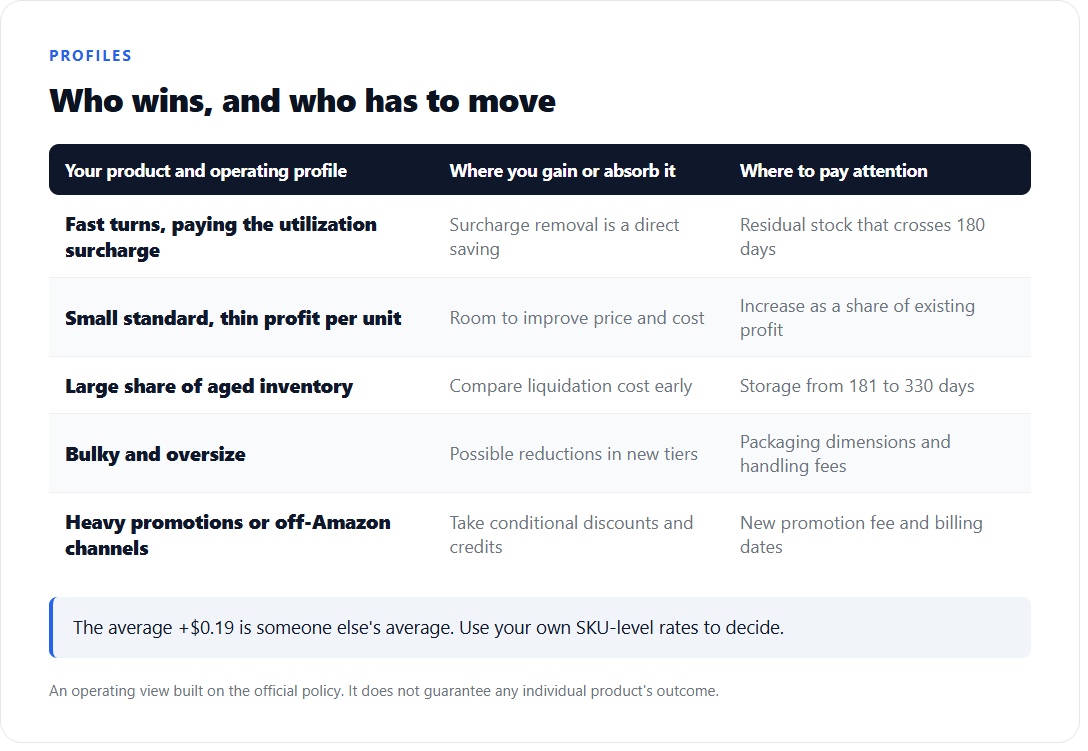
To summarize: Sellers with fast turnover and who were paying the utilization surcharge will benefit from this revision. Sellers with thin per-item profits on small standard products must consider the proportion of the increase. Sellers with a lot of old inventory should look at the new rates for the 181 to 330-day segment, and sellers selling bulky products should check package dimensions and additional handling fees. Sellers with a high proportion of promotions and external channels must verify the new usage fees and billing times.
14. 5-Step Check to Do Now
Before setting your 2027 budget, here are five steps to check this month.
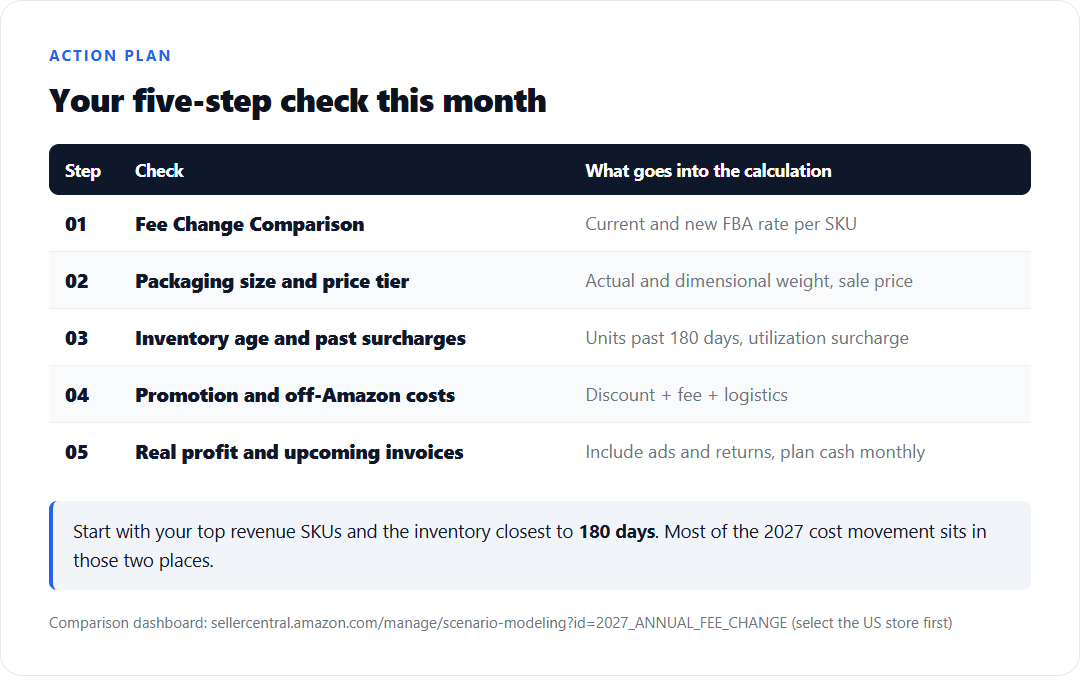
Start by checking your top-selling SKUs and inventory nearing 180 days. Most of your 2027 cost changes will be determined in these two areas. To quickly estimate without a Seller Central screen, you can first calculate shipping fee changes with SellerVisor's FBA Fee Calculator and then check your actual remaining profit, including advertising and returns, with the Real Margin Calculator.
15. Frequently Asked Questions
Q. How much will Amazon fees increase on average in 2027?
According to Amazon's announcement, the average increase is approximately $0.19 per item. However, there are differences ranging from $0.06 to $0.44 per product, and some items move in the opposite direction. While the storage utilization surcharge is eliminated, leading to lower costs, the unified storage fee for inventory aged 181 to 330 days will increase.
Q. When do FBA shipping fee increases take effect?
Most FBA shipping rates and size tier changes will apply from January 15, 2027. Changes related to storage fees, low-inventory fees, AWD, and MCD will take effect on February 1, 2027, and AWD inventory storage fees for items exceeding 12 months will apply from March 1, 2027.
Q. Are the amounts currently visible in Seller Central the 2027 amounts?
No. The 2026 peak season rates apply until January 14, 2027. You must open the rate list in the fee calculator and select 'FBA fulfillment fee rate (Jan 15, 2027)' for the 2027 amounts to be displayed.
Q. What is the fee for Buy X Get Y?
It is a fixed $5 plus 2% of the eligible sales. The variable portion is capped at $2,000, so the maximum is $2,005. Billing occurs for the fixed fee in the first monthly cycle after creation, and for the variable fee based on previous month's sales.
Q. Are storage fees increasing or decreasing?
Both. The basic storage fee for inventory aged 0 to 180 days remains unchanged, and the storage utilization surcharge previously applied for exceeding 22 weeks will be eliminated. Conversely, for the 181 to 330-day segment, the unified rates are higher than before.
Q. How are Canada, Mexico, and Brazil different?
It's difficult to compare solely by the increase amount due to different inventory locations and operating methods. If you are selling in those marketplaces, you must check remote shipping costs and the rate guidelines for each country together.
Summary: 2027 Must Be Judged by Your SKUs, Not the Average
There are three key aspects to Amazon's 2027 fee changes: FBA rate increases on January 15, storage fee structure reorganization on February 1, and monthly promotion billing and Buy X Get Y fees starting in February. The average +$0.19 is merely an indicator of direction; actual profit and loss are determined by your product's size tier, selling price, inventory age, and promotion frequency.
What needs to be done now is clear. Place the 2026 and 2027 rates for your top-selling SKUs side-by-side, mark inventory that will exceed 180 days, and calculate the new costs for promotions you are running. If you complete these three tasks this month, your January and February invoices will be expected documents, not surprising ones.
SellerVisor helps Amazon sellers check sales, advertising, and inventory data on one screen. If you want to see how fee changes affect your actual margin, try SellerVisor's FBA Fee Calculator and Real Margin Calculator first. If you don't have a SellerVisor account, you can start for free.