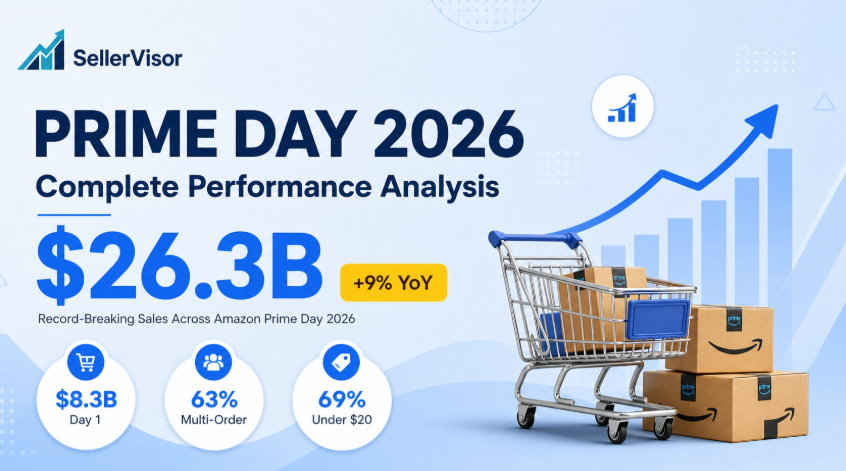
Amazon Prime Day 2026, held from June 23 to 26, achieved a record $26.3 billion in sales, a 9% increase year-over-year. The four-day event revealed significant shifts in consumer behavior, with shoppers prioritizing value and everyday essentials over luxury items.
Key Highlights
- Day 1 sales reached $8.3 billion (biggest e-commerce day of 2026)
- 63% of households placed two or more orders during the event
- Average order value declined to $47.66 (down from $53.34 last year)
- Shopper satisfaction fell to 59% (down from 68% in 2025)
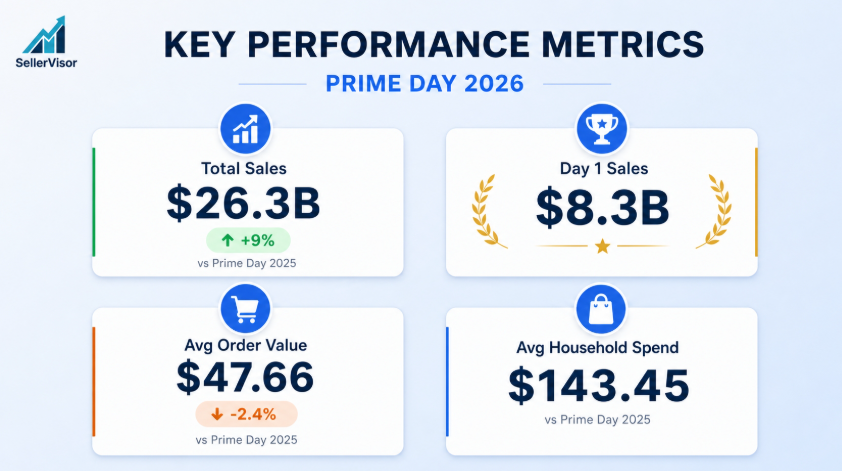
According to Adobe Analytics and Numerator's Prime Day tracker data, Prime Day 2026 posted impressive growth.
2026 Key Metrics:
- Total event sales: $26.3 billion (+9% vs. $24.1 billion in 2025)
- Day 1 sales: $8.3 billion (+5.3% vs. $7.9 billion in 2025)
- Average order value: $47.66 (-10.6% vs. $53.34 in 2025)
- Average spend per household: $143.45 (-8.3% vs. $156.37 in 2025)
Event Details
- Duration: 4 days (June 23-26, 2026)
- Schedule change: moved from the traditional July to late June to avoid conflict with the FIFA World Cup and Independence Day
- Participant demographics: typical shopper profile was high-income suburban women aged 45-64
- Re-engagement rate: 89% of participants had shopped on previous Prime Day events
Consumer Behavior Analysis
Multiple Order Phenomenon
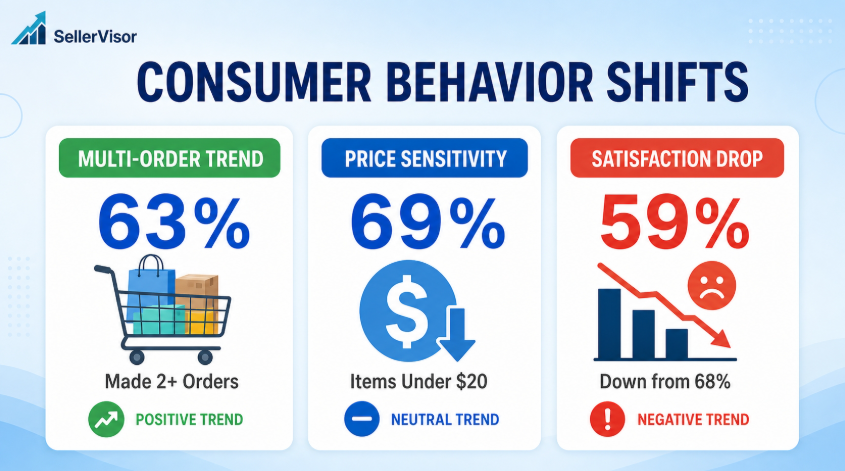
One of the most important trends of Prime Day 2026 was the shift from single large purchases to multiple smaller orders.
63% of households placed two or more separate orders, suggesting strategic shopping where consumers spread purchases across categories to maximize deals. For sellers, this means bundle deals and cross-sell opportunities became more valuable.
Price Sensitivity Reaches New High
The data shows clear price band preferences:
- 69% of all purchased items were priced under $20
- Only 3% of purchases were over $100
- Average price per item: $23.23 (down from $24.59 in 2025)
The implication is clear. The "sweet spot" for Prime Day sales has decidedly shifted toward inexpensive everyday items.
Satisfaction Gap: A Major Challenge
Perhaps the most concerning metric for Amazon and sellers alike was the drop in shopper satisfaction from 68% to 59%.
Why did satisfaction decline?
- Discount depths were not as aggressive as the prior year (in the 10-24% range)
- More comparison shopping across retailers (Walmart deals, Target Circle Deal Days)
- Rising expectations for value beyond simple price cuts
Best Performing Categories and Items
Bestselling Categories
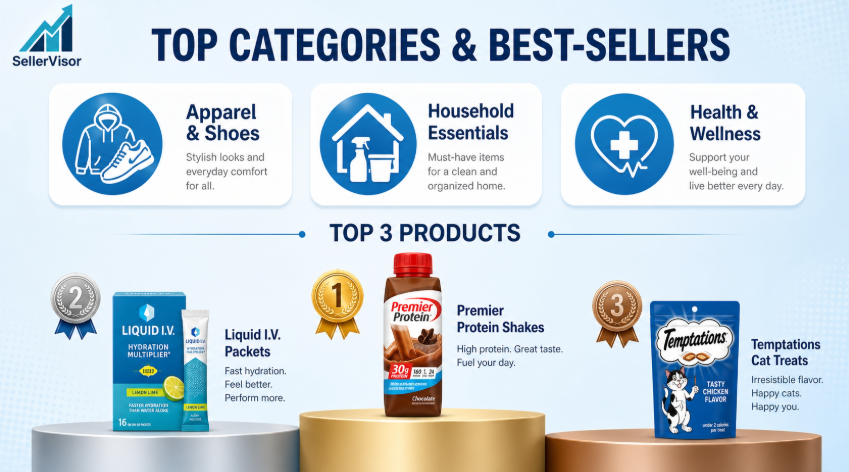
- Apparel & Footwear - continued strength in fashion basics and athleisure
- Household essentials - cleaning supplies, trash bags, paper products
- Health & Wellness - supplements, vitamins, fitness accessories
Top Individual SKUs
According to Numerator's tracking, the No.1 bestseller was:
- Premier Protein Shake - winner in the nutrition/convenience category
- Liquid IV Hydration Packets - popular health & wellness item
- Temptations Cat Treats - consistent performer in pet supplies
Secondary Strong Categories
- Electronics - focused on accessories and mid-tier items
- Home & Garden - tools and outdoor equipment
- Kitchen appliances - small appliances and gadgets
Pattern recognition: consumers, reflecting ongoing economic pressure, prioritized essentials and everyday-use items over luxury or discretionary purchases.
Year-over-Year Comparison: 2025 vs 2026
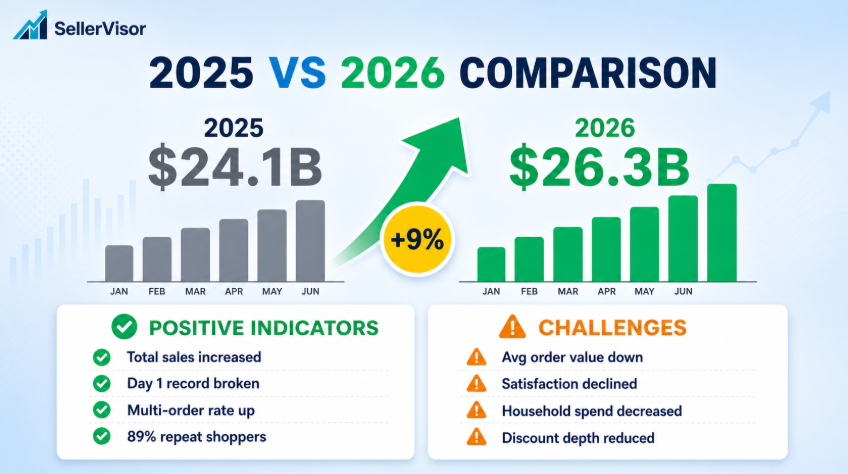
Total sales grew, but the composition of that growth shows important changes.
Positive Indicators:
- Total sales increased 9% year-over-year
- Day 1 performance exceeded forecasts
- Household engagement remained strong
- Increase in multiple-order rate
Concerning Trends:
- Average order value down 10.6%
- Spend per household down 8.3%
- Satisfaction score down 9 percentage points
- Discount depth decreased
Market Context
The 2026 event faced unique challenges:
- Timing: earlier late-June slot than usual
- Competition: Walmart and Target ran aggressive concurrent promotions
- Economic environment: ongoing inflation and consumer budget consciousness
- Market maturity: 12th annual Prime Day, potentially facing participation fatigue
Key Challenges and Opportunities
Challenge 1: Declining Satisfaction
Issue: only 59% of shoppers expressed high satisfaction with deals.
Opportunity: sellers who can convey true value through product quality, bundling, or unique offerings can differentiate in a market saturated with discounts.
Challenge 2: Lower Order Value
Issue: average order values declined significantly.
Opportunity: multiple-order behavior creates opportunities for:
- Lightning deals throughout the event
- “Buy 2 get X% off” deals for consumables
- Creating themed sets (e.g., “Home Office Essentials Bundle”)
Challenge 3: Increased Competition
Issue: 49% of Prime Day shoppers also visited Walmart deals, and 32% also visited Target Circle Deal Days.
Opportunity: Amazon-specific advantages still remain:
- Prime membership loyalty
- Superior logistics and delivery
- Wider selection across most categories
- Advanced recommendation algorithms
Strategic Recommendations for Sellers
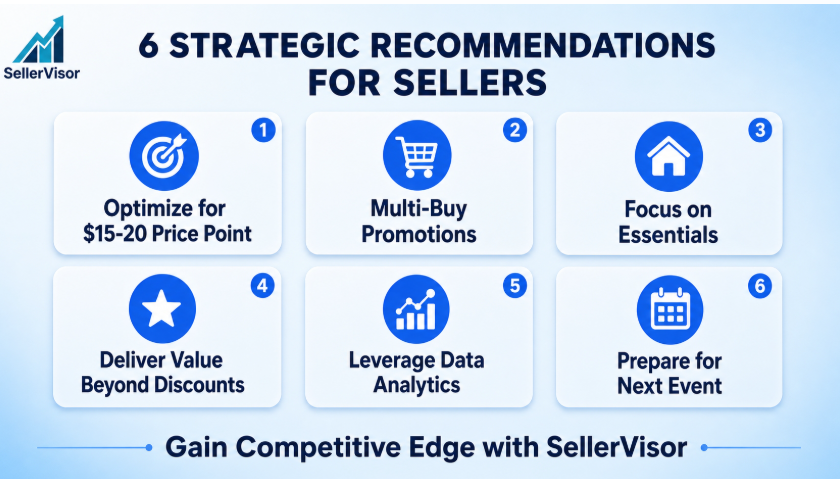
1. Optimize the $15-20 Price Band Sweet Spot
Given that 69% of purchases were under $20, sellers should:
- Review pricing strategies to position key SKUs in this range
- Create variant listings targeting different price bands
- Consider smaller pack sizes if products typically sell above $20
2. Develop Multi-Purchase Promotions
Since 63% of shoppers made multiple orders:
- Bundle complementary products to encourage higher cart values
- Offer "buy 2 get X% off" deals on consumables
- Create themed sets (e.g., "Home Office Essentials Bundle")
3. Focus on Essentials and Consumables
If your product catalog includes everyday items:
- Increase inventory allocation for Prime Day events
- Emphasize convenience and value in listings
- Highlight bulk-purchase savings for repeat-buy items
4. Deliver Value Beyond Discounts
With satisfaction scores falling:
- Improve product imagery to set accurate expectations
- Enhance A+ content to clearly communicate product benefits
- Collect and display reviews to build trust
- Offer warranties or guarantees to reduce purchase risk
5. Leverage Data Analysis
Use tools like SellerVisor to:
- Compare performance against category averages
- Identify pricing opportunities through competitor analysis
- Optimize PPC campaigns based on actual Prime Day search behavior
- Track ACOS and profitability in real time
6. Prepare Now for the Next Event
Don't wait for the next Prime Day announcement:
- Perform a 2026 performance analysis within two weeks while data is fresh
- Identify inventory gaps that prevented demand capture
- Test pricing strategies during smaller promotional events
- Build email lists to re-engage Prime Day customers
Frequently Asked Questions
Q: When was Prime Day 2026?
A: Prime Day 2026 ran from June 23 to June 26. It was a four-day event earlier than the traditional July timing.
Q: How much did Amazon earn during Prime Day 2026?
A: Total sales including all retailers reached $26.3 billion, representing a 9% increase compared to Prime Day 2025.
Q: What was the best-selling item on Prime Day 2026?
A: According to Numerator, Premier Protein shakes were the top-selling SKU, followed by Liquid I.V. hydration packets and Temptations cat treats.
Q: Was Prime Day 2026 better than 2025?
A: In terms of total sales (a 9% increase), yes. However, average order value fell by 10.6% and shopper satisfaction dropped from 68% to 59%.
Q: Which price range sold best during Prime Day 2026?
A: 69% of all purchased items were priced under $20, making that the dominant price range for the event.
Q: How should sellers prepare for the next Prime Day?
A: Focus on optimizing listings for the sub-$20 price range, creating multi-buy promotions, improving product value beyond simple discounts, and using analytics tools to understand category-level performance.
Conclusion: An Evolving Prime Day Landscape
Prime Day 2026 showed that while the event continues to grow in total sales, the nature of that growth is changing. Consumers are more price-sensitive, compare across retailers more, and are less satisfied with discounts alone.
Takeaway for Amazon sellers: Success in future Prime Day events will require sophisticated strategies beyond simply lowering prices. Sellers who combine competitive pricing with genuine value, smart bundling, and data-driven optimization will be best positioned to capture the most profitable part of Prime Day demand.
Ready to optimize your Amazon strategy?
SellerVisor offers AI-powered tools to help with the following:
- Analyze Prime Day performance versus competitors
- Identify optimal pricing strategies
- Optimize PPC campaigns for maximum ROI
- Discover market opportunities before competitors
Start a 14-day free trial now →
Related articles:
- The Ultimate Guide to Amazon PPC Optimization 2026
- How to Analyze a Competitor’s Amazon Listing
- ASIN Comparative Analysis: Finding Competitive Advantage
- Q3 2026 Amazon Seller Trends Report
Keywords: Prime Day 2026 results, Amazon Prime Day sales, Prime Day statistics, Amazon seller tips, Prime Day 2026 analysis, Amazon FBA Prime Day, 2026 ecommerce trends, Amazon sales data, Prime Day performance metrics, Amazon seller strategy
About SellerVisor
SellerVisor is an AI-powered platform that helps Amazon sellers optimize listings, analyze competitors, manage PPC campaigns, and identify market opportunities. With tools like an AI image generator, ASIN comparative analysis, and automated reporting, SellerVisor makes selling on Amazon more efficient and profitable. Learn more at www.sellervisor.com.